 Book now
Book now
0
Your Cart
Your cart is empty. Let's change that!
Shop our productsOops! Something went wrong while submitting the form.
Sex and pleasure (especially female sex and pleasure) has been wildly under researched and under funded. In fact, it was only as late as 2009 that the full structure of the clitoris was fully scanned and understood.
This means the clitoris is not only not taught about in sex education at school, but it is actually missing from many anatomical textbooks. WILD.
It’s time to change all that and get clitorate!
The more we know about our bodies, the more empowered we are to have amazing, pleasurable sex and intimacy.
Although lots of people use the word ‘vagina’ to describe all female genitals, the ‘vulva’ is the correct word for everything outside the body (eg the inner / outer labia and the head of the clitoris that sits right at the top of the inner labia) and the ‘vagina’ is the internal passage that joins the uterus to the outside of the body.
When it comes to language remember you should use whatever language the person who owns that body part likes to use - it's their body!
If you want to learn some more top tips for giving a vulva pleasure (including fingering and massaging techniques) check out my guide here!
The clitoris is the female erogenous organ capable of erection when we are aroused and turned on.
There are an almost infinite number ways to stimulate and arouse the different parts of the clitoris - using hands, lips, tongues, penises, toys, pillows, shower heads....and even our minds!
Here are my top 10 facts about the clitoris and vulva that you probably didn’t know - but definitely should. Follow along to find out how to find the different parts of the clit and how to give them amazing pleasure.
What you see on the outside of the body is only the tip of the iceberg!
The majority of the clitoris (it's 7-11cm in size) lives under the surface of the skin, branching out either side of the opening to the vagina and downwards in two ‘legs’ and two ‘bulbs’. The part we can see and feel at the top of our vulva (where the two labia meet) is just the head or the 'glans'.
There is so much more to explore and discover internally.
Rather than just focusing on the tip, it's a great idea to stimulate the rest of the clitoris and vulva too. This stops the glans becoming over sensitive and results in more full-bodied pleasure.
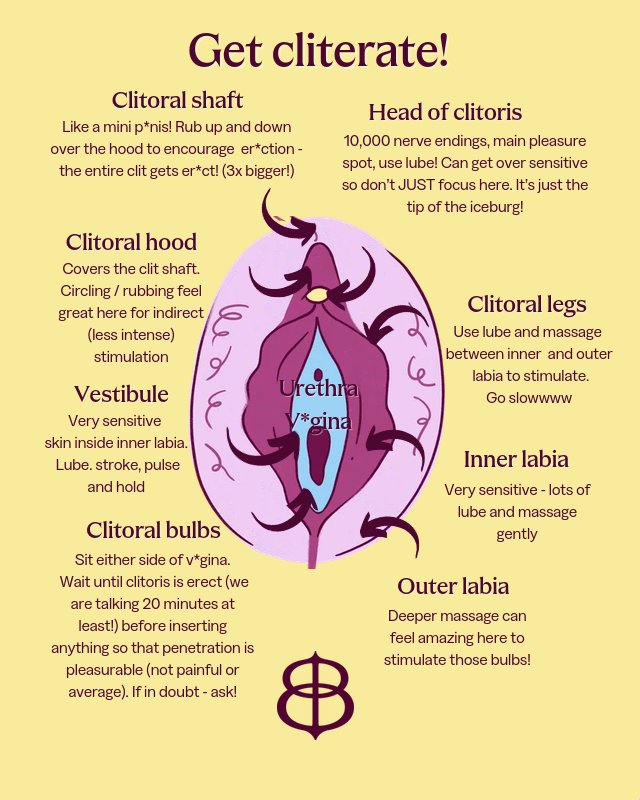
The whole clitoris is absolutely packed full of nerve endings. The head of the clitoris has over 10,00 nerve endings - more than anywhere else on the human body (and way more than the head of the penis). This is why it is so sensitive.
These nerve endings send impulses to the brain. Each nerve perceives stimulation differently, depending on where you’re being touched. This is why touch on your clitoris feels different to touch anywhere else on your body.
Some people don't like direct or ongoing clitoral touch for this reason - it can feel too intense or they can become over sensitised.
It's therefore always a good idea to mix it up with other types of touch - massage strokes on the outer labia, a circling technique through the clitoral hood, or moving somewhere else entirely. Anticipation is a great turn on!
It’s very normal to find it difficult or impossible to reach orgasm with internal penetration/stimulation alone.
In fact, depending on which study you read, between 70-85% of women and vulva owners need some form of external clitoral stimulation in order to reach orgasm.
You can do this in many ways - get creative! Try a hand, a toy, or grinding against the bed/ a partner.
Even if you're getting the best touch and stimulation, sometimes arousal just doesn't happen. It's really important to be in the right headspace.
Set up your space in a way that helps you feel relaxed and turned on - reducing your breaks (e.g. a messy room) and increasing your accelerators (e.g. putting on music).
Just like the brain, heart, lungs, kidneys, and the penis, the clitoris is an ORGAN. And it's the only organ in the body thats only purpose is PLEASURE.
The more arousal and pleasure the clitoris feels, the more ready the body becomes for sex through things like engorgement and lubrication. (Keep reading for why!)
Although we think the penis and vulva are very different, they are more similar than you might think!
In the womb, we all start with a genital structure that looks the same.
It consists of a genital tubercle, fold, and mound. Depending on how much testosterone is (or is not) present, this genital structure usually changes into either a penis and testicles or a vulva and clitoris.
As a result there are a lot of similarities between the penis and the clitoris:
Now that you know that, try stimulating the shaft of your clitoris (the bit that runs under the clitoral hood, just above the glans of the clitoris) up and down, just like you would stimulate a penis.
Feels pretty good huh?
Ok, this is very important, so listen closely. Just like the penis is filled with erectile tissue and so fills up with blood during arousal and becomes more sensitive, engorged, and pleasurable to touch, so is the clitoris.
In fact, it can swell as much as 300% when aroused. This means we get erections too! But remember, most of our erectile tissue is under the surface of the skin, so we can’t see them as easily.
This is really important when it comes to pleasurable sex. We need to give our body and clitoris time to become fully engorged/aroused before sexual touch feels great. This is especially true of internal penetration, where we need those clitoral bulbs on either side of our vagina to be engorged in order for it to feel great.
Why is foreplay important?
Clitoral engorgement and arousal can take a really long time!
In fact, it can take up to 30-40 minutes to become fully erect and engorged! This is why foreplay, taking your time, and listening to your body is so important.
Slow down, and savour the whole experience instead of rushing straight to penetration.
Sometimes we can be very turned on and our body doesn’t respond the way we want it to. Arousal doesn’t always lead to wetness/erections/engorgement etc, and menopause and hormonal changes can also impact natural lubrication.
Conversely, it’s also possible for our bodies to become physically aroused even when we don’t feel turned on. This is called arousal non concordance - and it’s all very normal.
Even if you’ve never experienced this, lube makes everything feel better - not just penetration. It can be used anywhere on the body, and is essential for any great genital massage. More slippery, more sensitive, more pleasurable!
It's actually very very common for women and vulva owners to find it very difficult (or even impossible) to orgasm - especially with a partner. There are all sorts of reasons for this, and helping women learn how to orgasm is one of the major things I help women with.
A big issue is we often fixate a lot on orgasm being the goal of sex, and that can be really harmful. This pressure often makes it even more elusive (and means they struggle to get out of their head and enjoy the moment!).
The more that we try and take the goal of orgasm out of our minds, and instead just focus on how to give and receive the best pleasure possible, the better. Besides - just because someone didn't climax doesn't mean that they had a bad time!